
Warriors Loss Not Sign of Tech Decline
Was it more important to Cleveland than the Bay Area that the Cavs win? This was certainly the popular wisdom. It went beyond Cleveland not winning a professional sports title since 1964 to connect a Cav’s win to boosting the city’s long struggle for economic revitalization.
If any city can show a relationship between sports team success and a burgeoning local economy, it’s Cleveland. As illustrated in Mark Winegardner’s brilliant novel, Crooked River Burning, the city’s fate mirrored that of the Cleveland Indians from the 1940’s through the 1960’s. In 1948, Cleveland had the nation’s second biggest economy and the Indians won the World Series. By the end of the 1960’s the Indians were in the second division, the city was in economic freefall and its Cuyahoga River was so polluted it caught fire.
But before assuming the Cavs victory will propel Cleveland economically, recall the 2013 Super Bowl between the Baltimore Ravens and San Francisco 49ers. Baltimore won that game, and the city was soon onset with the Freddie Gray riots. The uprising exposed Baltimore’s long failure to revitalize its African-American neighborhoods, a reality a Super Bowl title did not change.
The 49ers lost that game, and the Bay Area’s economic boom continued.
Warriors and Tech
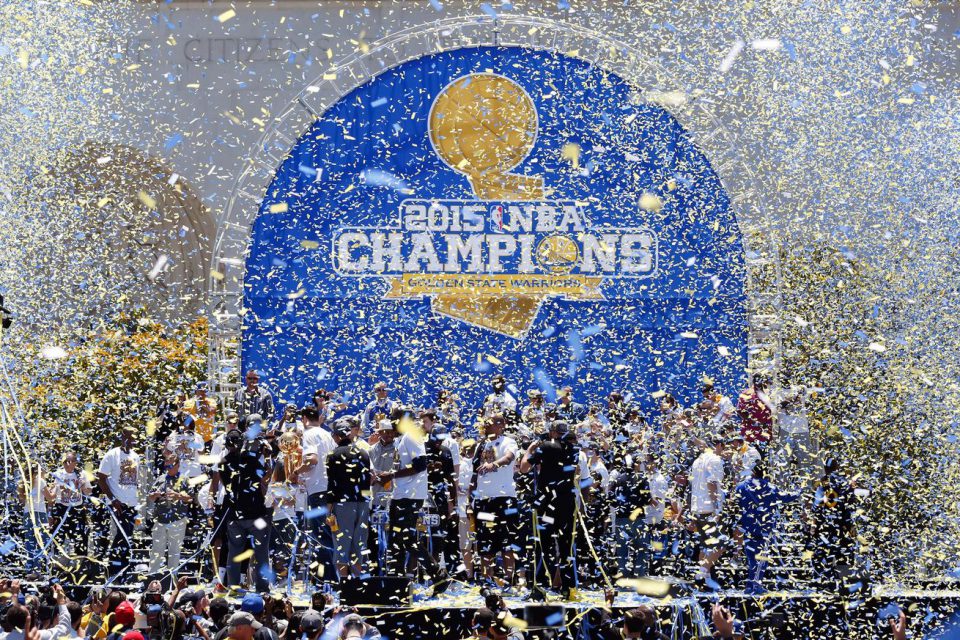
National media routinely connected the Warriors success to the surrounding tech industry. The April 3, 2016 NY Times magazine story, “What Happened When Venture Capitalists Took Over the Golden State Warriors,” made this link explicit. As the article states, “Lacob was not the first venture capitalist to buy a franchise, but he is the first to operate one according to what might be called Silicon Valley precepts: nimble management, open communication, integrating the wisdom of outside advisers and continuous re-evaluation of what companies do and how they do it.”
That Warriors’ owner Joe Lacob identified the team’s success with the strategies and tactics of the tech industry made Warrior fans hoping for tech’s downfall uncomfortable. After all, if the fortunes of tech and the Warriors were intertwined, a tech decline could spell bad news for the region’s NBA team.
But the Warriors did not lose Game 7 because of anything related to tech, or to the superiority of Cleveland’s “blue collar” team. The Warriors lost because the Splash Brothers didn’t make shots.
The Bay Area economy will remain strong despite the defeat, while Cleveland’s revitalization still faces challenges after the Cavs win.
Sports Economics
The economics of billion dollar television contracts and salary caps means that there is no longer a strong connection between a city’s prosperity and resources available to its pro sports teams. We are light years away from the days when Bill Veeck could barely afford to field the St. Louis Browns baseball team, or when even Seattle was not a strong enough market to carry the Pilots (they moved to Milwaukee after the 1969 season and became the Brewers).
While the New York Yankees used local television revenue to afford more top free agents, the Kansas City Royals—long used as a case study for how local markets impact teams—won the 2015 World Series and lost in 2014 in game 7. Oklahoma City can pay more to Kevin Durant than any other team, and have as high a payroll as the long faltering New York Knicks.
The strong Bay Area economic base does allow the Giants to sellout in non-World Series years, and it would be unimaginable for attendance to dip as low at AT&T Park as it has in the more economically challenged city of Cincinnati. So some connection between local economic health and Major League Baseball teams exist. But pro football teams share almost all revenue, so the longterm failure of the Cleveland Browns or Jacksonville Jaguars cannot be blamed on weak local economies.
Warriors Future is Bright
Most cities would be thrilled to have their teams win a title and then lose in game 7 the following year. After all, even the San Antonio Spurs have never won back to back championships.
The 2016-17 Warriors are poised to include better rebounders and more scorers, with Lacob announcing right after the loss that he will be “aggressive” this summer in improving the team. Whether that commitment to winning comes from “tech” or Lacob’s own personal history makes no difference to Warrior fans who now expect a title every year.
Next year could easily see another Cavs-Warriors rematch. The Warriors future is bright, and now fans get a long overdue rest before refocusing on the Giants quest to win their fourth World Series since 2010.
After all, this is an even numbered year.
Randy Shaw is Editor of Beyond Chron.
