
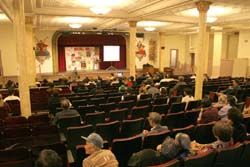
At the Housing Justice Summit this Saturday in the Tenderloin, representatives of community-based organizations and organized labor met to hammer out a common progressive agenda for affordable housing. The event, held at the St. Boniface Church on Golden Gate Avenue, drew participants from a wide range of organizations, including the Chinatown Community Development Center, the Coalition on Homelessness, La Casa de La Madres, the San Francisco Urban Institute, and the Tenants and Owners Development Corporation (TODCO), among others.
“We’re trying to break down the great walls between organizations,” said Calvin Welch, a coordinator of the event and a member of the Council of Community Housing Organizations. Welch named the four interest groups addressed by the summit: affordable housing, tenants’ rights, land use and development, and homelessness. “All too often organizations representing those interests don’t meet and coordinate,” he explained.
In ninety-minute workshops, participants discussed priorities for the summit’s Action Agenda: a set of concrete proposals to be addressed to the Board of Supervisors. In doing so, planners explained, they hoped to create a unified “housing justice” movement in San Francisco.
“A coalition effort does not mean we agree on everything,” cautioned speaker Guiliana Milanese of the California Nurses Association. As an example, she offered a recently proposed dog leashing ordinance, to appreciative chuckles and murmurs in the audience.
“There are certain to be disagreements, rough edges, bumps along the way,” said Eric Quesada, echoing Milanese’s comments. Quesada is a senior organizer of the Mission Economic Development Association. “But our humble goal is to create a common agenda. What type of city do we want to live in?”
Considering that question, many attendees lamented changes in the city resulting from rising rents.
“It used to be a working class town,” recalled Michael Harris, board president of the San Francisco Housing Development Corporation. Harris has lived in the city over forty years. “Plumbers and dockworkers could buy a house – it was very common. Now it’s virtually impossible. The increase in housing cost is so profound – it’s priced most people who are not extremely well paid out of the market.”
Speaking of her own neighborhood, Jessica Fyles of the Bernal Heights Neighborhood Center remarked, “There’s been a significant economic shift in the community. It’s become a hot housing market, and prices are incredible. A lot of low-income black and Latino families have moved out.” She referenced a poster in the Mission depicting a U-Haul labeled ‘Eviction’ removing a Latino family. “Overall, there’s less places for families to live, and it just doesn’t make a healthy city.”
The Action Agenda adopted by the summit included a range of local proposals on issues ranging from rent control to shelter conditions. To implement the summit’s recommendations, a Housing Justice Implementation Working Committee has been established, and will meet for the first time on Tuesday, July 26, at 6PM at 201 Turk Street.
Stressing the urgency of action, Diego Todd of TODCO remarked, “If we don’t speak up now, this is the beginning of the end.”
Editor’s Note: Earlier this morning, a list of agenda items was included at the end of this article. This list was meant to be an op-ed by Marc Salomon, and will be published tommorrow. Beyond Chron apologizes for the mistake.
The Housing Justice Summit at St. Boniface Church gave neighborhood activists a chance to discuss issues such as affordable housing and tenants’ rights. Photo by Kristina Barker
