
Oscar nominations were announced today, and the three leading contenders for Best Picture are Sideways, Million Dollar Baby, and the Aviator. All three films offer deeply conservative messages that have been almost entirely ignored by America’s overwhelmingly white male movie reviewers. If you have not seen these films and do not want to find out what happens, stop reading; but those interested in learning what reviewers omitted will be in for a surprise.
I was so excited about what I had read about Clint Eastwood’s Million Dollar Baby that I saw it at San Francisco’s Metreon the second day it was out. As a big fan of boxing movies, my expectations were high for the film about a young female boxer played by Hilary Swank trained by old timers played by Eastwood and Morgan Freeman.
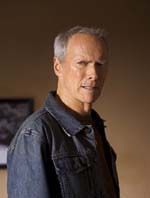
But none of the reviewers revealed that Million Dollar Baby is less about boxing than it is about killing disabled people. And the film’s message cannot be separated from the public anti-disability rights perspective of its director and lead actor, Clint Eastwood.
We are told in reviews of Million Dollar Baby that a dramatic plot twist occurs more than halfway through the film that cannot be revealed. But this “plot twist” is essentially a shift to an entirely different film with a very different message.
The film initially focuses on the changing relationship between the young boxer and an aging manager whose daughter ignores him and who now has been given a final chance at career glory and patriarchal redemption. But the last third of the movie has viewers leaving the theater with a different message: disabled people prefer to die.
As the Chicago-based disability rights group Not Dead Yet puts it, “Million Dollar Baby becomes Million Dollar Bigots.”
Here’s what happens. After a succession of rapid knockouts, Swank’s character faces a title shot with a champion who has already been exposed as a dirty fighter (although she is supposed to be from Germany, she is dark-skinned rather than Aryan). Swank appears headed to victory when after the bell rings and she is returning to her corner, she is hit from behind. Not prepared for the illegal blow, Swank falls. But because the round had ended, her manager (Eastwood) has put the fighter’s stool in the corner, and Swank falls not on the ground but on the edge of the stool.
Here is where the movie gets bizarre and Eastwood’s political agenda becomes clear. As a result of the fall, Swank suffers spinal cord damage and learns she can never walk again. A victim of a high profile felony—having been atttacked after the round had ended-Swank should have been awarded the title by disqualification. But curiously, Swank, Eastwood and everyone else claim she lost because she made the mistake of turning her back on her opponent.
Having fulfilled her dream of winning a shot at the big time, Swank sees no reason to go on living. She expresses this view despite having full use of her mental faculties and being outfitted with a modern wheelchair. Eastwood tries to conceal his true message by having his character urge Swank to go to college, but she rejects this and begs Eastwood to kill her. After her leg is amputated, Swank shows her desire to die by trying to bite off her tongue. Eastwood then makes the “moral” decision to fulfill her desires and puts her to death by lethal injection.
After providing a realistic, hard nose drama of Swank’s rise to the top, Eastwood shifts to the world of unreality and illogic to make his political point about putting an end to the lives of disabled persons. I have never heard of a boxer being seriously injured by falling on a stool, and the entire series of events following Swank’s fall is nothing short of preposterous.
It appears geared entirely toward creating a scenario where the audience would root for Eastwood to kill his surrogate daughter, Swank (some might suggest he is acting out his anger at the adult daughter who has cut him out of her life, though the reason she returns all of his letters unopened is never revealed)
Eastwood was sued on the grounds that a resort he owns was inaccessible, and it has clearly left him with a grudge against disabled persons. Eastwood testified in Congress in support of weakening the Americans for Disabilities Act, and his face is on the cover of a book, “Make Them Go Away,” which identifies him as a leader in the fight against disability rights.
Shame on Roger Ebert and other critics for heaping praise on this fundamentally dishonest and reactionary film. And shame on the academy for rewarding Eastwood with a Best Actor nomination.
Sideways involves two middle-age men on a search for meaning on a road trip through the wineries of Santa Barbara. The movie offers a liberal patina by poking respectful fun at wine tasting, showing farm workers picking grapes, and by its use of a novelist wannabe as the central character.
But the film should really be subtitled “Fantasies of Middle-age Men.” In the first fantasy, a boring, unattractive, man with a rundown car and no financial assets proves to be the object of desire for an incredibly good-looking blonde woman.
In the second male fantasy, a sexy, independent young Asian woman falls deeply in love with an aging male soap opera actor who has clearly seen better days. She finds the man so special to her that within days of their meeting she introduces him to her mother and daughter, and is assuming he shares her desire for a long term relationship.
Movie critics identified with Paul Giamatti’s character in fantasy number one, and his ability to secure Virginia Madsen despite average looks, few assets and serious personality defects likely explain the movie’s great reviews. You can be sure that if an unattractive woman with no bank account and few friends attracted an actor resembling Brad Pitt, male movie critics would be angrily denouncing the film as unrealistic.
I would go as far to say that nobody looking like Paul Giamatti ends up with a woman looking like Virginia Madsen unless they are rich. And young single parents do not connect their kids and mother to a lover who they have known only a few days.
The latter third of Sideways resembles Animal House more than a serious adult film. As we learned from that frat-loving John Belushi classic, in the world of male-produced and directed movies the badly behaved and flawed lead male character always gets the beautiful woman he desires.
That’s why Sideways should more appropriately been titled, Dream On.
Remember when Martin Scorcese made movies like Mean Streets and Taxi Drivers about social outsiders? Well, in today’s more conservative climate he has delivered a film about a billionaire, titled The Aviator.
The classic biopic film follows something of a standard format-the audience watches as the star in question rises from a little less than nothing to something we all aspire to be. The recent films Ray and Kinsey both examples where the shining lights in question shone through their own brilliance and determination.
But it appears as though this year’s biggest biopic (at least in terms of budget and directorial reputation), Martin Scorcese’s The Aviator, bucks the trend. Instead, this favorite for a Best Picture award gives audiences a wealthy investor who tirelessly spends loads of money chasing his airborne dreams: something a little less than Oscar-worthy inspiration.
That Scorcese’s latest film focuses on a billionaire (though, granted, a billionaire with a significant amount of neuroses) and his quest to achieve more greatness points to a more recent trend in American culture. Our success stories are becoming less about accessibility and more about exactly how grandiose America has become.
There seems to be little heroic in the life of Howard Hughes: Scorcese makes him seem socially incapacitated, morally vacuous, and, often, simply unlikable. And all of this during war? Compare those nuances to Don Cheadle’s Paul in Hotel Rwanda and, despite all of the hand washing, only one of them has cleaner hands.
The Aviator is first-class spectacle. There are planes, beautiful women, and millions of dollars thrown around carelessly (oh yeah, they have all of that in the movie too). Martin Scorcese deserves acclaim, he makes some of the best movies of any director living, but, unfortunately, this is not one of those movies.
For all of its grandeur, The Aviator, in light of today’s world, casts a depressing light on America. The wondrous world of Pan-Am and TWA means nothing to today ‘s JetBlue and Southwest fliers who may have never even heard of those earlier airlines. The recent news of Europe’s AirBus makes Hughes’ obsession over massive flying machines seem dated, and, ultimately failed.
If one were to look for allegory in this tale of America’s gilded age, I imagine the moral would be something less than flattering for our country’s reputation. Our heroes should be those of us who not only look to the sky but also those who actually reach it.
I have no doubt that Howard Hughes captivates or even intrigues, but I only wish that our Oscar voters were more impressed with inspiration and less fascinated with their own, very insulated set of problems.
While Million Dollar Baby, Sideways, or The Aviator will win the Oscar in the first year of Bush’s second term, the socially relevant and thought-provoking film The English Patient won the Best Picture Award in 1997, the start of Clinton’s second term. This is either mere coincidence, or further proof that films reflect the politics of the time.
Send feedback to rshaw@beyondchron.org
