
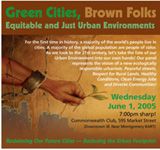
The Ella Baker Center for Human Rights, on its Web site, promised that yesterday’s Green Cities, Brown Folks: Responsible and Justice Urban Environments event was “Not To Be Missed!” Indeed it was not. Co-sponsored by the Ella Baker Center, this event, which was held at the Commonwealth Club, kicked off the social equity portion of United Nations World Environment Day 2005.
With five emerging environmental leaders serving as panelists for an interactive discussion, attendees received answers to questions concerning a new vision of ecologically responsible urbanism and gained insight into a bottom-up approach to the environmental justice movement. As moderator Juliet Ellis, Executive Director of Urban Habitat said, it served as a tremendous opportunity for the public to hear from representatives of some of the nation’s leading environmental justice organizations.
Soon after one of the representatives, Executive Director Vivian Chang of the Asian Pacific Islander Environmental Network, introduced herself, she ceded the floor to activist Zhang Li, a beneficiary of APEN’s commitment to empowering low-income Asian Pacific Islander communities to achieve environmental and social justice. In 2002, after working at the Silicon-Valley based American Xtal Technology (AXT) for four years, Li and more than 500 of her immigrant Chinese co-workers were laid off, she said. This came after the state issued the manufacturer of semiconductor substrates 42 citations for a number of ills, including willfully exposing workers to arsenic.
In describing the horrid working conditions, Li said that because there was no ventilation system, blankets of arsenic dust accumulated on the factory floor, leaving some workers to suffer injuries associated with being exposed to 21 times the maximum permissible level of arsenic. “It was difficult to breath and sometimes difficult to see” she said. Yet AXT to this day claims their company, most of which is now operating out Beijing, China, is safe. “I think Zhang Li’s testimony captures what we need to deal with,” Chang said, confirming that the best solutions to problems such as this one are those grounded in reality.
Azibuike Akaba, environmental scientist and activist, agreed, adding that we need to empower our communities to be engaged and to learn the [legislative] language so they might leverage power in their favor. He explained that in his home of West Oakland children are 7 times more likely to be hospitalized for asthma than they are in the rest of the state of California, and that diesel exhaust may not only exacerbate asthma in these children but may cause it as well. He and other activists are working to find reality-based solutions, including the disallowing of trucks to remain idle on a roadside for longer than five minutes, and the rezoning of trucks away from homes.
Meanwhile, Clayton Thomas Muller of the Indigenous Environmental Network wishes he could rezone transnational oil corporations from Native lands. “The United States is in such a race to prolong fossil fuel,” he said disgustedly. Now, in their quest for natural gas, the Bush Administration wants to develop the McKenzie Pipeline through the Northwest Territories which are sacred to the Indigenous people who live there. “They talk of how natural gas is so much better than other fossil fuels. There’s no such thing as clean natural gas extract!” he exclaimed. Nor is there such a thing as clean coal strip mining, he added.
The effects of mining is another hardship suffered by the Hopi, Crow, Cheyenne and other tribes who have seen their land degraded over the last 40 years. “Indigenous people reject the notion that our land and our people are quick-fix solutions to America’s energy dilemma.” Unfortunately, there is no environmentally sustainable quick-fix solution. As Muller pointed out, even the Pipeline would provide energy for a mere 25 years; what then?
We need to get resources out there, push for funds to help community based organizations, and move to action, said Director of West Harlem Environmental Action Cecil Corbin-Mark. “It can’t just be education for education’s sake; this is life and death.” He is not exaggerating. As global warming continues to spell impending doom, the predicted results of climactic change, including retreating glaciers, acceleration of rising sea-levels, and a higher frequency of heat waves will become more apparent. This last point is of particular importance to African Americans who are twice as likely to die from heat waves as are white people, explained Corbin-Mark.
So where should we begin? According to Panelist Raquel Rivera-Pinderhughes, Professor and Scholar Activist at San Francisco State, we need to move the environmental justice movement from being an anti-toxic movement to a more healthy city, healthy living movement. She recognized that many poor communities and communities of color often suffer most while other communities are extremely privileged and suffer least. This environmental justice movement, however, is a domestic and international movement, and all the organizations and communities need to work together to determine how to benefit from a greener economy.
That promotion of unity and togetherness stuck with Connell Dunning as she left the Commonwealth Club. “I was really impressed by the emphasis they put on partnerships of communities and local organizations. They realize that no one can do it alone,” she said, and commended the panelists also for “not trying to reinvent the wheel.” Instead they encouraged taking cues from, and working with, successful organizations that already exist, said Dunning who attended the event after reading about it on the UN World Environment Day Web site.
Gayle Orr-Smith, Vice President of the San Francisco Police Commission, on the other hand, came after receiving an electronic invitation. “I didn’t see anything about it in the mainstream agenda, so I’m glad I got this,” she said. As a resident of Bayview/Hunters Point, she pointed out that the issue of bottom-up environmental justice, that is, environmental justice beginning with local communities and grassroots organizations rather than with government or big corporations, is relevant to her. “So I really wanted to be part of the dialogue and to have a presence in dealing with this issue.”
Having a heard voice and a seen presence is what UN World Environment Day is about. Established by the United Nations General Assembly in 1972, this is the first time in its 33-year history a United States city is hosting the event. During the next few days, and thereafter, we need to hold our mayors, our supervisors, our officials accountable for their actions. As Cecil described, our leaders should serve as mirrors, reflecting what we the people want for our communities. If they aren’t reflecting the correct images, then they need to leave. When “1 percent of the population controls 48 percent of the wealth we need to adjust the mirror,” he said.
For a complete social equity calendar, please visit www.ellabakercenter.org.
