
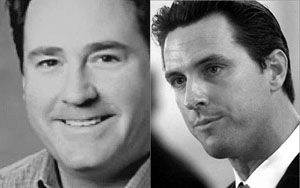
Recent San Francisco Chronicle stories on Mayor Newsom’s plans for Treasure Island avoid criticism of the proposed developers and the exclusive negotiating agreement they signed with the city. Despite Treasure Island Development chief Tony Hall’s public attack on the agreement as a “sweetheart deal,” the Chronicle refuses to detail the basis of his claim. But during Willie Brown’s mayoralty, Chronicle editor Chuck Finnie sang a different tune. Finnie wrote several articles questioning the Treasure Island deal, and accused Brown of “cronyism” for selecting a campaign fundraiser as the developer. But with Hall now echoing Finnie’s criticism of the “overly generous” deal, the Chronicle’s framing has changed. No longer is the paper interested in the financial details of the agreement, and the developer—who raised money for Mayor Newsom-is no longer described as a “crony” or “pal” of the Mayor. It appears that the Chronicle’s coverage of the Treasure Island deal is based not on the facts, but on who is the Mayor.
Although Willie Brown endorsed Gavin Newsom for Mayor, and the two drew financial backing from many of the same sources, Newsom went to great lengths to separate himself from the alleged “pay to play” politics of the Brown years. The San Francisco Chronicle framed candidate Newsom as a “break from the past” during his mayoral race, and has often given the Mayor a free ride for conduct for which it sharply criticized Brown.
A perfect example is the Chronicle’s coverage of the development plans for Treasure Island. Current Chronicle city editor Chuck Finnie covered Treasure Island in 1998-1999 for the former Hearst-owned San Francisco Examiner, and continued writing about the issue as a Chronicle reporter after the paper’s merger.
On June 11, 1998, Finnie wrote a piece (“Key Brown Allies eye Treasure Island”) that began as follows:
A former national Democratic fund-raiser who drummed up big
campaign bucks for Mayor Brown is angling to develop Treasure Island-starting with its most prized asset.
The subheads to Finnie’s articles described the developers as connected to “lobbyist pals of Brown’s,” as “friends doing business” with the city, and as the deal “raising conflict of interest questions.”
This fundraiser, Darius Anderson, is the same Darius Anderson who currently has exclusive rights to negotiate a development deal for Treasure Island. The same Darius Anderson who not only raised money for Willie Brown, but also for Gavin Newsom.
On October 31, 1998, Finnie reported (“Mayor’s cronies in line for job”) that a “Brown-appointed Commission” had rated Anderson’s group the best qualified out of three bidders for developing the Island’s marina. Finnie quoted longtime Brown critic Quentin Kopp as saying that the Island deal was “standard Willie Brown operating procedure. He is able to effectuate more disillusioning and dispiriting venality as mayor than he was as speaker.”
On November 16, 1998, Finnie authored an article titled “Mayor’s pals find treasure on island.” The story reported that “political patrons” of Brown are favored for the Island redevelopment deal despite a bid that “would pay The City at least $1 million less than the other two bidders.”
Finnie goes to town on Anderson in this piece, noting that he raised $2 million for Brown’s mayoral campaign and concluding the article with an assertion from Anderson that he got the deal “because I have the best bid, not because of my relationship to the mayor.” The implication left with the reader, of course, is quite the opposite.
Finnie’s February 11, 1999 article (“Mayor pals get marina on Treasure Island”) again highlighted Anderson’s fundraising role for Brown, as did his April 2003 piece which he wrote after the Hearst Corporation purchased the Chronicle. The title of this last Finnie piece—“Treasure Island project expected to go to mayor’s cronies. Huge development lacked competition, according to critics”—-captures his framing of the entire Island deal.
A reporter does not write this many stories on the same subject unless they have a passion. But Finnie’s zeal for ferreting out mayoral cronyism (his bio notes that he wrote about “pinstripe patronage” and corruption in contracting under Willie Brown) appears to have evaporated after Gavin Newsom took over Room 200.
And the full extent to which Finnie’s passion to root out mayoral cronyism has dissipated became clear when Hall recently complained about the developer’s “sweetheart deal” at the Island. This gave the Chronicle the perfect opportunity to remind readers of Darius Anderson’s role as a Newsom fundraiser, and to write stories about how the mayor’s “pals” and “political backers” were getting special treatment. But Finnie instead presided over stories strongly backing Newsom in his battle with Hall.
It is not as if Finnie and the Chronicle are unaware of the Anderson-Newsom connection.
On April 1, 2004 the paper ran a story by the since departed Katia Hetter that discussed how Anderson was holding a Sacramento fundraiser for Newsom while his development firm was negotiating over Treasure Island. Although the article quoted a representative of Common Cause saying that “it sounds like its skating close to the line” to a conflict of interest, the balance of the piece were quotes defending the mayor from such “objective” observers as Newsom spokesman Peter Ragone, Newsom campaign strategist Eric Jaye, and Newsom campaign attorney, Jim Sutton.
Note the contrast between this piece and Finnie’s multiple articles on Willie Brown’s relationship with Anderson, in which longtime political enemies of Mayor Brown like Quentin Kopp were asked to respond. Had a Newsom critic like Supervisor Chris Daly been asked to respond to the Anderson fundraiser, you can be sure that he would not share Jaye’s assertion that Newsom’s opinions are unaffected by those holding fundraisers for him.
The 2004 Chronicle story does have attorney Jim Sutton explaining why Newsom can receive money from those he is negotiating with for a city contract due to a “technicality” that exempts the Treasure Island Development Authority from a 1995 San Francisco ballot measure prohibiting this practice. This is the same Jim Sutton who, representing District Attorney Kamala Harris, apparently believes that a politician can misrepresent facts in a mailing so long as only 199 pieces are involved.
Although Finnie emphasized developer Anderson’s fundraising work for Mayor Brown in his ongoing stories on Treasure Island, Anderson’s similar role for Mayor Newsom was not mentioned in three Chronicle stories written in the past two weeks. The only time Anderson’s fundraising background was even mentioned was in the paper’s September 27 story, which described him as a “Democratic Party fundraiser and lobbyist.”
The Chronicle’s April 2004 story detailing the Anderson-Newsom connection has been erased from the paper’s institutional memory. It was fine for Finnie to accuse Willie Brown of a sweetheart deal (he quoted someone using these exact words in his April 6, 2003 story), but when Tony Hall made the same claim against Gavin Newsom, the Chronicle editor set his attack dogs against him rather than acknowledge that he had shared Hall’s view prior to Newsom becoming Mayor.
For Finnie and the Chronicle, targeting “pinstripe patronage” applies only to Mayor Brown, not to Mayor Newsom and his political pals.
Send feedback to rshaw@beyondchron.org
