
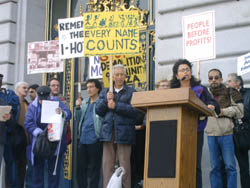
A coalition of community groups rallied on the steps of City Hall today, announcing their plan to continue their fight to pass the Housing Preservation Initiative, which would prevent the demolition of sound buildings of 20 units or more. Activists and community leaders said they would begin handing out petitions today, hoping to garner the 20,000 signatures necessary to get the initiative before San Francisco voters on a special election ballot by next May or June.
Initially scheduled to appear before voters earlier this month as Proposition M, the San Francisco Superior Court struck the Housing Preservation Initiative from the ballot on a technicality weeks before election day.
Advocates for the initiative, which include the Senior Action Network, the Tenant’s Union, and the Residential Builders Association, stated that it will keep affordable housing in San Francisco by preventing developers from tearing down rent-controlled apartments and replacing them with more expensive market-rate units.
“The issue here is between the community and the developers,” said Ted Gullickson, head of the San Francisco Tenants Union. “Renters are being evicted at the same rate as the dot com years. We need to put an end to demolitions and fight to preserve our rent-controlled housing stock for our city’s seniors, families, and disabled.”
The move to get the initiative on the ballot again will likely continue to meet strong opposition from Mayor Gavin Newsom, despite the Democratic County Council’s endorsement of the initiative. Newsom abandoned his party by heading up the No on Prop. M campaign last summer before it was struck down, finding an wealth ally in the process – Angelo Sangiacomo.
Sangiacomo owns a wide array of property in San Francisco, including the extremely contentious Trinity Plaza Apartments, which inspired the Housing Preservation Initiative. He currently wants to demolish Trinity Plaza, on the corner of 8th and Market St., which would eliminate over 300 rent-controlled apartments and replace them with over 1,400 market rate units. The demolition of Trinity Plaza would displace over 500 tenants, including seniors, children, and disabled people.
Luisa Balatbat, a Trinity Plaza tenant who attended the rally, said she was particularly disgusted with both Newsom and Sangiacomo. “Those people just want to get some more profit,” said Balatbat. “We all know the mayor is siding with developers, not tenants.”
Balatbat, the mother of two children, says her family started looking for new housing as soon as she found out Trinity planned on evicting her. “We looked really hard,” she said, “but there was nothing we could afford. It’s really hard when you think your leaders will fight for you, but then they turn against you.”
Joe O’Donoghue, head of the Residential Builders Association (RBA), announced at the rally that his organization would help finance the campaign to put the initiative back on the ballot.
“The RBA has always opposed demolition ordinances, but we support this one,” said O’Donoghue. “The reason is that this is not about demolition, its about the displacement of hundreds of tenants in rent-controlled apartments. This is about preserving housing for the elderly and the disenfranchised, and we’re proud to be a part of it.”
Proposition M appeared on the ballot after a series of battles at City Hall. The Board of Supervisors approved the Housing Preservation Initiative after being introduced by Daly. Mayor Gavin Newsom then vetoed it, however, allying himself with a powerful group of downtown interests wanting the ability to build and sell as much market-rate housing as possible. The initiative went back to the Board, but failed to obtain the two-thirds majority necessary to override the mayor’s veto.
Judge James Warren struck the Proposition from the ballot due to the absence of a consumer warning on the petitions signed by San Franciscans to get Prop. M on the ballot. Despite over 20,000 San Franciscans signing the petition, Warren claimed the petitions’ lack of required disclaimer invalidated all of them.
